



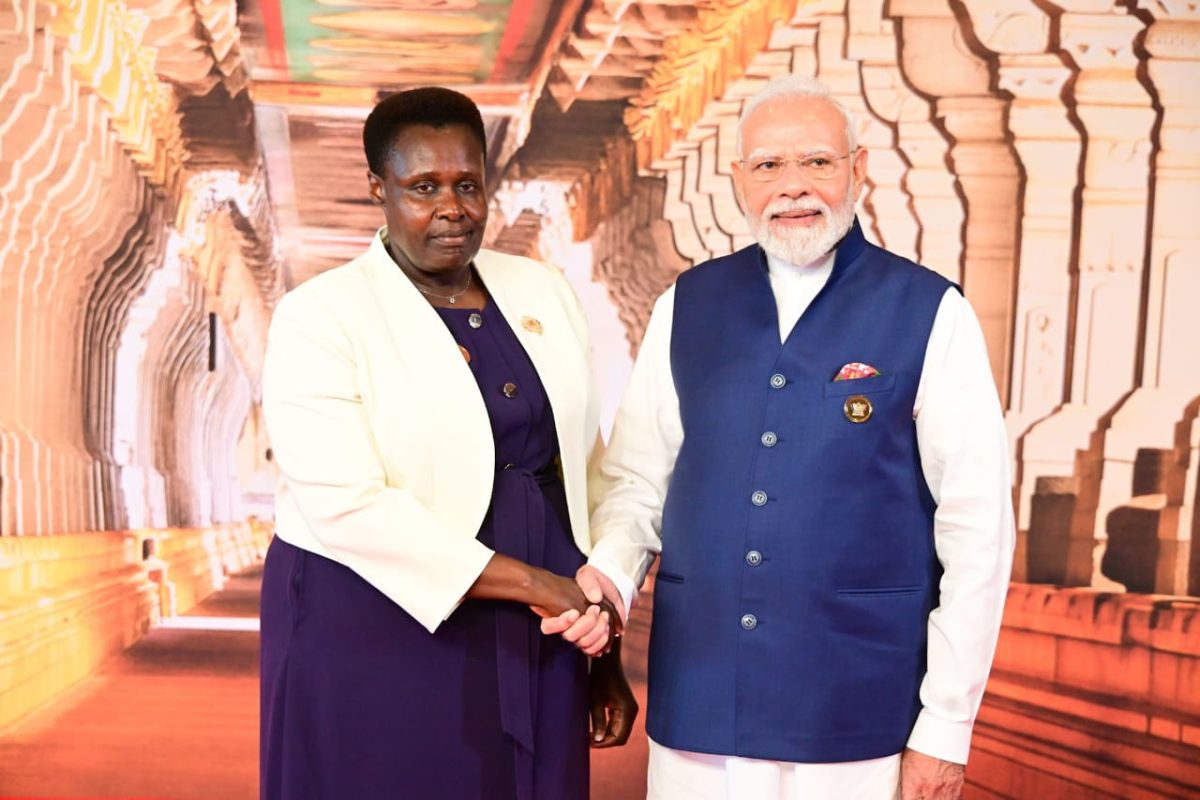
Indian Prime Minister Narendra Modi has received Uganda’s Vice President Jessica Alupo at Bharat Mandapam in New Delhi as the 18th BRICS Summit enters its second and final day, bringing Uganda–India relations into focus alongside wider discussions on cooperation among countries of the Global South.
Alupo is leading Uganda’s delegation to the summit, where Uganda is participating as a BRICS partner country. She was among leaders and senior representatives welcomed by Modi at the summit venue on Sunday.
Uganda became a BRICS partner country on January 1, 2025, joining the partnership as the grouping expanded its engagement with countries outside its core membership.
Partner countries are invited to participate in the summit and other BRICS meetings and may endorse summit declarations and other final documents.
Alupo’s presence in New Delhi comes at a time when Kampala and New Delhi are seeking to deepen economic cooperation, particularly in trade, investment, industrialisation, technology and skills development.
In July, Uganda’s Minister of Trade, Industry and Cooperatives, Sanjay Tanna, held talks with India’s High Commissioner to Uganda, Upender Singh Rawat, with discussions focused on reducing the trade imbalance, increasing investment and expanding cooperation in industrialisation, agriculture, digital transformation and skills development.
A recent Ugandan government study on Uganda–India relations has also identified opportunities for greater export diversification, foreign investment and cooperation in services.
It points to potential for Uganda to expand exports to India, including agricultural products and other value-added commodities, while benefiting from Indian expertise in areas such as ICT, business services, pharmaceuticals and agro-industrial development.
The relationship has a long-standing political and economic foundation. During Modi’s 2018 visit to Uganda, the two governments reaffirmed their commitment to expanding political, commercial, defence, technical, educational, scientific and cultural cooperation. They also agreed on the need to diversify trade and encourage greater private-sector investment.
The bilateral relationship has continued to gain attention in 2026. In February, President Yoweri Museveni hosted a UK–India–Uganda multisectoral trade delegation at State House, where discussions focused on trade, investment and manufacturing partnerships involving Uganda and India.
Against this backdrop, Alupo’s participation at the BRICS Summit gives Uganda another platform to engage India while also connecting its bilateral interests to the wider BRICS agenda.
India’s 2026 BRICS chairship is built around “Building for Resilience, Innovation, Cooperation and Sustainability.” The summit has focused on economic cooperation, technology, trade, sustainable development, global governance and strengthening the voice of developing countries.
For Uganda, the BRICS platform offers access to a wider network of major emerging economies and potential opportunities in investment, technology transfer, market access, infrastructure and development cooperation.
The New Delhi summit is also taking place amid broader efforts by BRICS to increase the influence of the Global South in international affairs.
Leaders have discussed reforms to global institutions, greater use of local currencies in trade, cross-border payment systems, supply-chain resilience and cooperation in areas including food security, digital infrastructure and artificial intelligence.
Modi’s reception of Alupo therefore carries significance beyond the summit’s ceremonial programme. It places the Uganda–India relationship within a broader conversation about how African countries can use emerging Global South partnerships to expand trade, attract investment and advance national development priorities.
For Kampala, the New Delhi engagement presents an opportunity to translate Uganda’s BRICS partnership into deeper economic links with India and other major emerging markets while strengthening its role in the evolving Global South cooperation framework.