



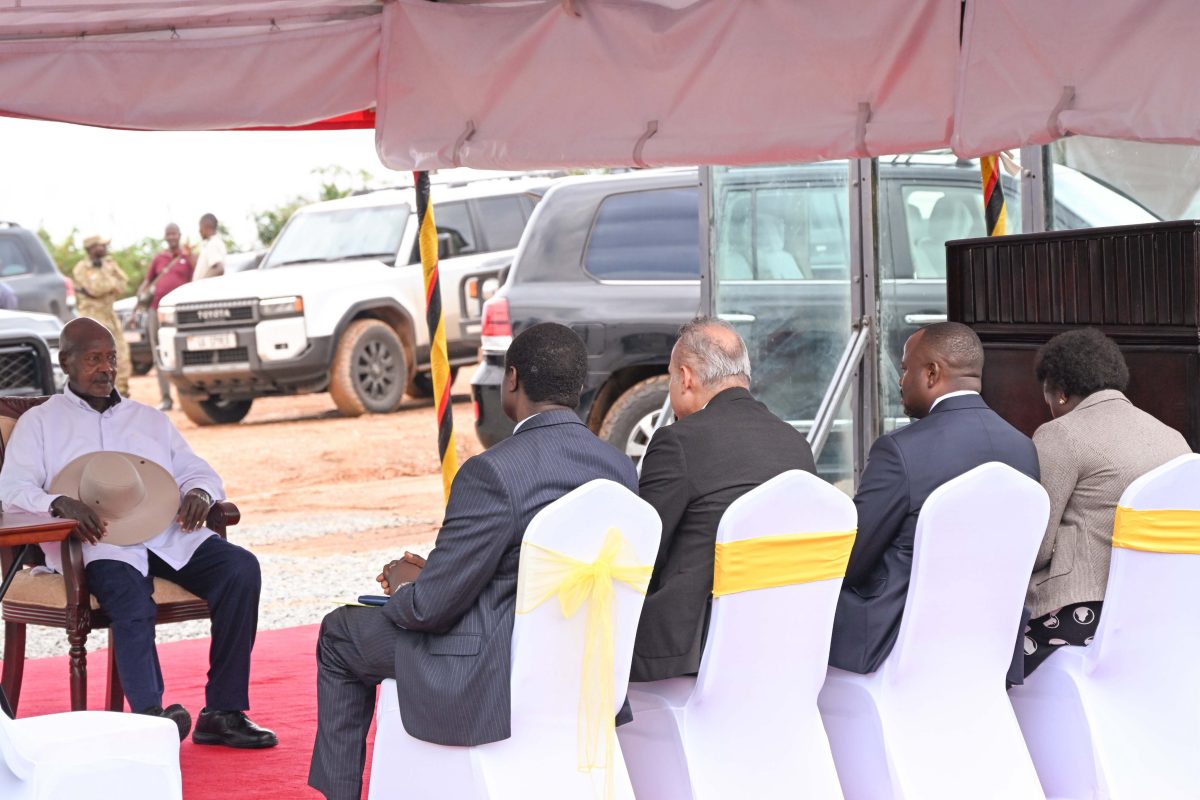
President Yoweri Museveni met Türkiye’s Ambassador to Uganda, Mehmet Fatih Ak, on Thursday as a demonstration organised by the Patriotic League of Uganda over the continued stay of government critic Fred Kajubi Lumbuye in Türkiye brought Uganda’s relations with Ankara into the spotlight.
According to State House, Museveni and Ambassador Ak met on the sidelines of the groundbreaking ceremony for the Kampala Storage Terminal in Mpigi District and discussed matters of bilateral interest. The meeting came a day before PLU supporters marched to the Turkish Embassy in Kampala demanding Lumbuye’s extradition to Uganda.
The timing placed official diplomatic engagement between Kampala and Ankara alongside a political mobilisation targeting the Turkish mission.
The demonstration was organised by PLU and led by its Secretary General, Fadil Twalla, following a directive from PLU chairman and Chief of Defence Forces Gen Muhoozi Kainerugaba.
The protesters gathered at Lugogo Cricket Oval before proceeding through Kololo to the Turkish diplomatic mission, where they sought to deliver a petition demanding that Türkiye hand over Lumbuye to Ugandan authorities.
The Turkish Embassy had announced that it would close on Friday because of the planned demonstration. The protesters were unable to deliver their petition directly at the embassy and later said they would pursue the matter through diplomatic channels.
PLU has accused Lumbuye of using Turkish territory to conduct activities it considers hostile to Uganda’s leadership. Ugandan authorities have previously accused him of offences including harmful propaganda, incitement and cyber-related crimes. The precise legal and diplomatic status of his case in Türkiye remains unclear, including whether a formal extradition process is currently before Turkish authorities.
Twalla said the group expected Türkiye to respect Uganda’s sovereignty and hand Lumbuye over to face justice.
The dispute has developed against the backdrop of a broader relationship between Uganda and Türkiye that has expanded considerably in recent years.
Türkiye and Uganda established resident embassies in Kampala and Ankara in 2010. Turkish President Recep Tayyip Erdoğan visited Uganda in 2016, the first visit by a Turkish president to the country, while the two governments have continued to describe their relationship as one of growing political and economic cooperation.
Trade has also expanded. TRT Afrika reported last week that Uganda–Türkiye trade more than doubled in 2025 to more than $160 million, with Turkish companies exploring additional investment and commercial opportunities in Uganda.
Infrastructure has been another important area of engagement. Turkish construction company Yapi Merkezi signed a contract with Uganda in 2024 for the 272-kilometre Malaba–Kampala section of the Standard Gauge Railway, a project valued at about $3 billion. The railway is intended to connect Uganda to Kenya’s rail network and improve access to the port of Mombasa.
However, the SGR project has also featured in the recent tensions. In June, Gen Kainerugaba announced that Uganda had cancelled the Yapi Merkezi contract and called for a PLU demonstration at the Turkish Embassy, although the Ministry of Works and Yapi Merkezi had not immediately confirmed the cancellation at the time.
The latest confrontation therefore comes at a sensitive moment for the bilateral relationship, with official channels continuing to emphasise cooperation while PLU has publicly demanded action against Lumbuye and threatened further mobilisation if its concerns are not addressed.
Museveni’s meeting with Ambassador Ak on Thursday also demonstrates that the government-to-government relationship remains active despite the political dispute surrounding Lumbuye.
The Turkish Embassy has not publicly indicated that the PLU demonstration has altered its diplomatic engagement with the Ugandan Government.
For Kampala and Ankara, the immediate issue remains Lumbuye, but the developments have placed broader questions about extradition, political mobilisation, bilateral trade and investment, and the management of diplomatic relations under renewed public scrutiny.