

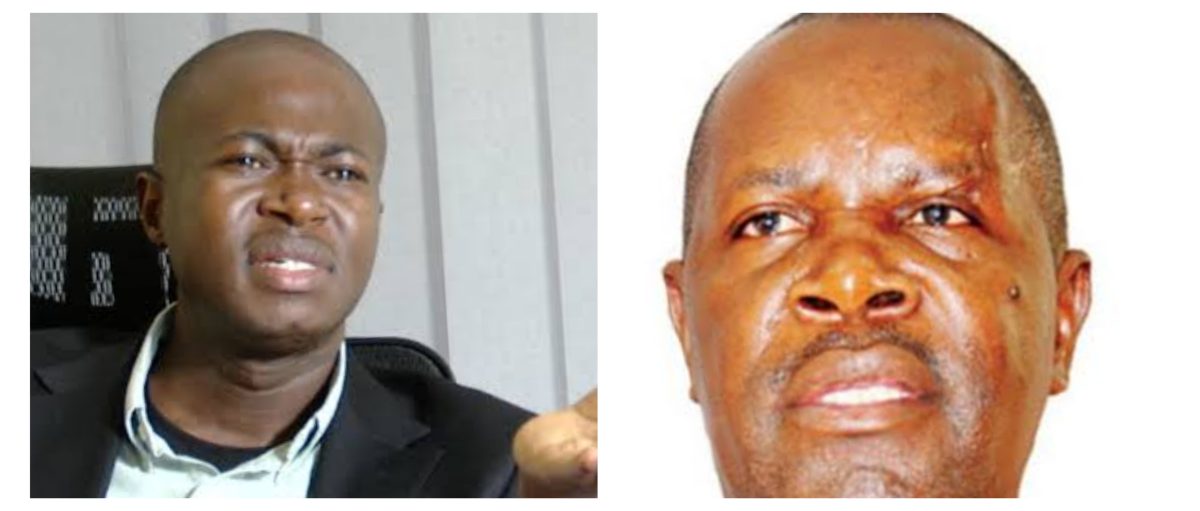
A public exchange between former government spokesperson Ofwono Opondo and newly appointed head of office of the Chairman of the Patriotic League of Uganda (PLU) Daudi Kabanda has intensified debate over the closure of NTV Uganda and the Daily Monitor, with fresh questions emerging over who is exercising state authority and under what legal mandate.
Opondo challenged the circumstances under which the two Nation Media Group outlets were shut down, asking whether the decision was made by the ruling National Resistance Movement (NRM) government led by President Yoweri Kaguta Museveni or by the Patriotic League of Uganda (PLU), a political pressure group associated with Chief of Defence Forces (CDF) Gen. Muhoozi Kainerugaba.
He questioned where PLU derives the authority to direct state affairs and argued that no law has been cited to justify the closure of the two media houses.
According to Opondo, allegations of media bias alone do not amount to a criminal offence that warrants shutting down television stations or newspapers.
His remarks came after Kabanda dismissed the concerns, declaring that “it is PLU in charge” and telling Opondo to “settle down.”
The exchange has fuelled wider debate about the relationship between political organisations, security agencies and government institutions, especially following the suspension of operations at NTV Uganda and the Daily Monitor after they aired footage related to the funeral of former presidential guard commander Brig. Gen. Charles Oluka.
The Uganda Communications Commission (UCC), the statutory regulator mandated to oversee broadcasting services, has not publicly announced any enforcement action against the two media houses, prompting legal and governance experts to question the basis upon which the outlets were taken off air.
The developments coincided with another intervention from President Museveni’s younger brother, Gen. (Rtd) Caleb Akandwanaho, popularly known as Salim Saleh, who called for government institutions to take charge of communicating on sensitive national matters.
From his base in Kapeeka, Saleh advised CDF Gen. Muhoozi Kainerugaba that Justice and Constitutional Affairs Minister Norbert Mao should be briefed on the public concerns surrounding the detention and prosecution of opposition figure Dr. Kizza Besigye, Lord Mayor Emeritus Erias Lukwago and others.
“Hon. Norbert Mao, Minister of Justice and Constitutional Affairs and Chairperson of the Cabinet Standing Committee on Human Rights, has a duty to the public concerning the case of Dr. Kizza Besigye and any of his accomplices,” Saleh said.
He added that Mao also has the responsibility to explain actions taken by state security agencies.
“He also has a duty to explain actions by the state security agencies against certain individuals and organisations. He may not be privy to some of the military intelligence. He needs a briefing so that he can in turn respond to any public concerns,” Saleh stated.
The remarks followed repeated social media statements by Gen. Muhoozi regarding Besigye and Lukwago, including allegations that they plotted to assassinate President Museveni. Muhoozi has previously threatened that the two would be hanged, remarks that have attracted criticism from opposition leaders, lawyers and human rights organisations given that criminal proceedings remain before the courts.
Saleh’s intervention has been interpreted by some observers as an attempt to shift public communication on politically sensitive matters from military officials to constitutionally mandated civilian institutions.
A veteran of the Front for National Salvation (FRONASA) and the National Resistance Army (NRA), Saleh serves as Senior Presidential Advisor on Defence and Security and Chief Coordinator of Operation Wealth Creation (OWC). Often described as the government’s “Chief Listener,” he has in recent months repeatedly called for dialogue and institutional responses to politically contentious issues.
The parallel interventions by Opondo and Saleh have added fresh scrutiny to the role of state institutions, security agencies and political organisations in Uganda’s governance, with observers arguing that the questions raised go beyond the fate of two media houses to broader issues of constitutional authority, accountability and the rule of law.