



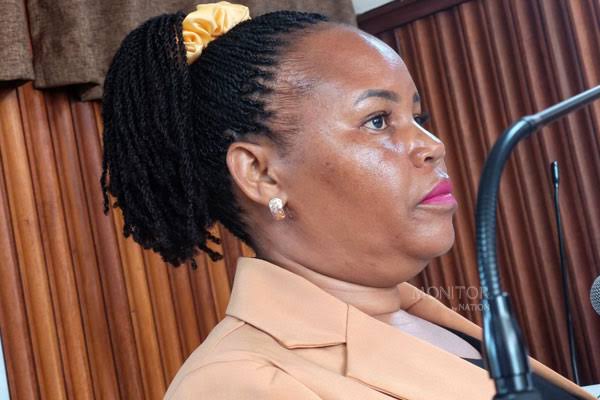
Masaka High Court summons NCHE official after Nambaziira admits she never sat PLE or UCE, raising fresh questions about how she qualified to contest Parliament
How did Florence Nambaziira become a Member of Parliament without sitting the Primary Leaving Examination (PLE) or Uganda Certificate of Education (UCE)? That question is now at the heart of a high-stakes election petition that has placed her academic qualifications and the vetting of parliamentary candidates under intense scrutiny.
Nambaziira, the National Resistance Movement (NRM) Woman MP for Ssembabule District, made the admission while testifying before the Masaka High Court on October 24, forcing the court to examine the documents she relied on to qualify for the January 2026 parliamentary election.
The revelation prompted Justice Christine Akello to order the National Council for Higher Education (NCHE) to provide an official to explain the status of Nambaziira’s qualifications and whether the documents she holds satisfy the requirements for election to Parliament.
The case, filed by former Woman MP Mary Begumisa, has become a test of the institutions responsible for ensuring that candidates meet the legal requirements before seeking public office.
Nambaziira told court that she did not sit PLE or UCE examinations, explaining that she instead pursued vocational training in hairdressing at Mengo Vocational Youth Centre.
She said her training covered hair plaiting, washing, styling and makeup, alongside theoretical lessons in customer care and business management. She also presented her vocational training as the foundation of her professional experience and business activities.
However, Begumisa’s legal team is questioning whether those qualifications, together with the equivalence documents relied upon by Nambaziira, meet the statutory threshold for a parliamentary candidate.
The dispute is no longer simply about whether Nambaziira attended conventional primary or secondary school. The decisive question is whether the qualifications she obtained through vocational training were lawfully recognised as equivalent to the academic standard required for Parliament.
The law and the disputed equivalence
Article 80(1)(c) of Uganda’s Constitution and Section 4(1)(c) of the Parliamentary Elections Act prescribe the minimum educational qualification for parliamentary candidates as Advanced Level education or its equivalent.
Candidates relying on alternative qualifications must establish that their credentials satisfy the applicable equivalence requirements. The legal status of Nambaziira’s documents is therefore central to the petition.
During the proceedings, Uganda National Examinations Board (UNEB) official Moses Mugizi testified remotely about the documents associated with Nambaziira’s academic qualifications.
According to court reporting, Mugizi explained that she holds a vocational qualification recognised through the Directorate of Industrial Training (DIT) as equivalent to the Uganda Certificate of Education. He also explained the framework under which equivalence certificates may be issued to people seeking elective office.
The evidence has introduced an important distinction into the case. The existence of vocational certificates does not, by itself, resolve whether Nambaziira satisfies the parliamentary qualification requirements. The court must determine the legal effect of those documents and whether the required equivalence was validly established.
That is why the NCHE testimony could prove decisive. The court wants clarity on the disputed qualifications before deciding whether the legal challenge has merit.
How did the electoral vetting process clear her?
The case also raises questions about the screening processes of the NRM Electoral Commission, chaired by Dr Tanga Odoi, and the national Electoral Commission, chaired by Justice Simon Byabakama.
Both institutions are now in the spotlight because Nambaziira was allowed to contest and was subsequently declared the winner of the Ssembabule Woman MP race.
The petition raises questions about the documents presented during nomination, the verification procedures applied and whether the relevant authorities adequately established her eligibility before she appeared on the ballot.
It also revives questions about the NRM party selection process, particularly the contrast drawn by Begumisa’s supporters between Nambaziira’s clearance and Begumisa’s own qualifications.
However, the fact that Nambaziira was cleared to contest does not, on its own, prove that officials acted improperly. Establishing negligence, deliberate wrongdoing or any form of improper influence would require specific evidence.
The court’s findings could nevertheless have implications beyond the two politicians, particularly if the proceedings establish weaknesses in how alternative academic qualifications are assessed and verified before nomination.
Election irregularities add to the legal battle
The academic dispute is only one part of Begumisa’s petition.
She is also challenging the conduct of the January 15, 2026 election, citing alleged ballot stuffing, violence, multiple voting, voter bribery and obstruction of polling agents in parts of Ssembabule.
The petitioner’s legal team presented seven witnesses and submitted video evidence purportedly showing ballot stuffing and violence, according to reports from the proceedings.
Ssembabule District Returning Officer Gracious Aryaija also testified in defence of the election process. He denied claims of military interference and said police had been deployed to maintain order at polling stations.
Under cross-examination, however, Aryaija reportedly said he could not explain why polling agents for several candidates had failed to sign Declaration of Results forms at a number of polling stations.
The missing signatures have become another point of contention in a case examining whether the election was conducted in accordance with the law.
The allegations of malpractice remain unproven and must be assessed against the evidence presented.
A victory now under judicial scrutiny
Nambaziira won the Ssembabule Woman MP seat with 61,638 votes, according to the official results. Begumisa came second with 24,495 votes, followed by National Unity Platform candidate Nina Kankunda, popularly known as Nina Roz, with 15,345 votes, while independent candidate Esther Kyinkuhaire received 8,281 votes.
The margin of victory was substantial, but the petition challenges the legality of the election rather than merely the size of the winning vote.
Begumisa is asking the court to overturn the result, arguing that Nambaziira did not meet the academic requirements and that electoral irregularities affected the contest.
Nambaziira, meanwhile, has defended her vocational qualifications and expressed confidence in her case.
The next critical step is the clarification of her academic status by the relevant authorities. Once that evidence is considered alongside the other testimony, the court will have to determine whether the grounds raised by Begumisa justify the remedies she seeks.
The case has placed the spotlight on a fundamental question of electoral accountability: how can voters have confidence in parliamentary nominations if the validity of a candidate’s qualifications becomes a major legal dispute after the election?
For Ssembabule, the stakes extend beyond the rivalry between Nambaziira and Begumisa. The proceedings could help establish whether the qualifications used to secure a place on the parliamentary ballot met the law’s requirements and whether the institutions entrusted with vetting candidates fulfilled their responsibilities.
Until Justice Akello delivers a ruling, Nambaziira’s eligibility remains a matter for judicial determination. Her admission that she did not sit PLE or UCE is now part of the court record, but the ultimate legal question is whether her alternative qualifications satisfy the standard prescribed for a Member of Parliament.