

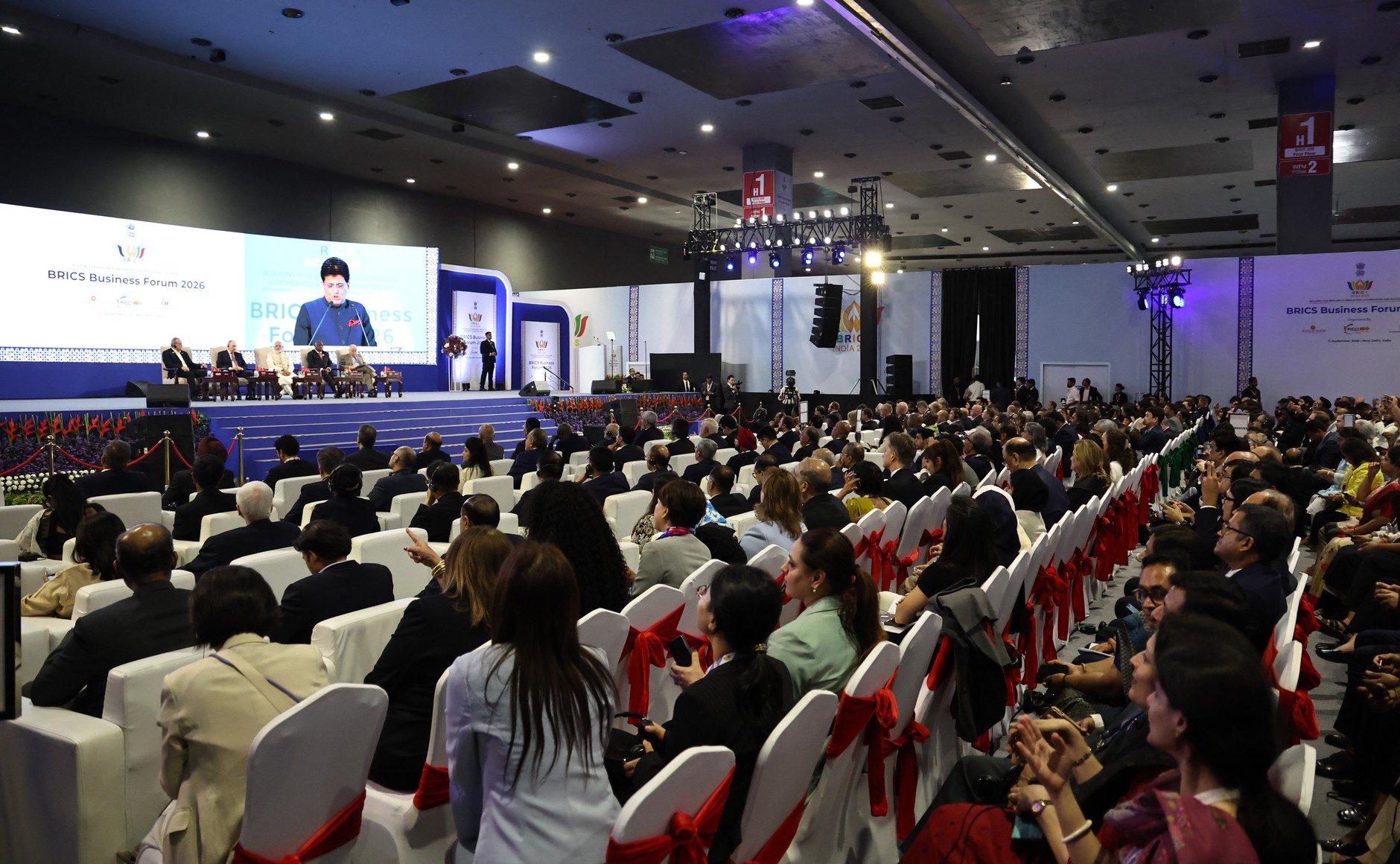
Russian President Vladimir Putin has said the BRICS bloc is emerging as a major engine of global economic growth, with its expanding economic weight increasingly challenging the dominance of traditional Western powers.
Speaking at the BRICS Business Forum in New Delhi ahead of the leaders’ summit, Putin said BRICS countries accounted for more than 40 percent of global GDP over the past five years, compared with 29 percent for the Group of Seven.
He said the disparity was even greater when measured by contribution to global economic growth, with BRICS accounting for nearly half of growth during the period while the G7 contributed only 18 percent.
“The BRICS countries, which are home to roughly half the world’s population, have vast and dynamic domestic markets,” Putin said, pointing to rapid urbanisation, expanding cities and the growing international reach of companies from member states.
Putin said the shift in global economic power was part of broader structural changes in the international system, arguing that traditional economic leaders were increasingly being joined by new centres of growth.
He highlighted companies including India’s Tech Mahindra, China’s Huawei, Brazil’s Embraer, UAE-based DP World and Russia’s Rosatom as examples of businesses demonstrating the technological and industrial capabilities within BRICS.
The Russian president also sharply criticised Western sanctions and trade restrictions, accusing Western powers of using economic pressure and other measures in an attempt to preserve their previous dominance.
He said Russia had been subjected to more than 30,000 sanctions, describing the measures as part of an effort to constrain countries pursuing their own economic interests.
“Western competitors today are resorting to every conceivable means to reclaim their erstwhile dominance,” Putin said.
Despite the pressure, Putin said Russia had strengthened its economic resilience by relying on domestic businesses, scientific institutions, technology, education and engineering capabilities while expanding trade with what he described as reliable international partners.
He said Russia’s GDP grew by 10.3 percent between 2023 and 2025, while unemployment fell to a record 2.3 percent.
Putin said Moscow was also accelerating investment in artificial intelligence, autonomous systems, digital platforms and modern financial technologies, including through cooperation with other BRICS members.
Beyond individual economies, Putin called for BRICS to build stronger mechanisms to support business cooperation, particularly in cross-border payments, investment, logistics, transport and technology.
He said Russia was ready to work with BRICS partners on major international transport corridors, including the Trans-Arctic Transport Corridor and the North-South International Corridor.
Putin also backed the creation of a new investment platform through the BRICS New Development Bank, saying it could attract private capital into infrastructure, technology and other strategic sectors.
He stressed that the bloc was not intended to isolate itself from the rest of the world or operate as an alliance against Western countries.
“We are not building our work in opposition to anyone,” Putin said. “We stand for ourselves and our own interests, yet we are ready to cooperate with all our partners.”
The Russian president said the growing cooperation among BRICS governments, businesses and experts could create what he described as a new platform for global economic growth.
He argued that the bloc’s approach was based on national interests, technological innovation, equality among partners and mutually beneficial economic cooperation rather than rules imposed by external powers.
Putin said Russia’s newly established National Committee for Business Cooperation within BRICS, comprising more than 40 leading Russian companies, would help develop concrete partnerships with businesses across the expanded bloc.
He said Russia remained open to initiatives in industry, trade, tourism, energy, food security, infrastructure and applied research as BRICS seeks to translate its growing economic influence into deeper commercial ties.