

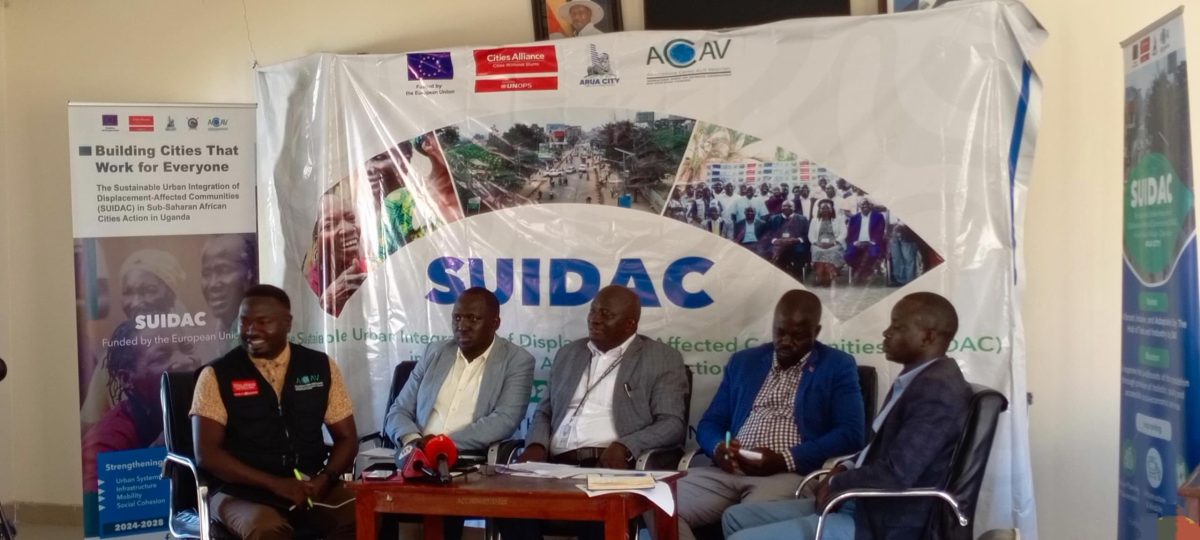
Rising pressure on urban public services in Arua City, driven by increasing numbers of self-settled refugees and other displacement-affected communities, has exposed major gaps in infrastructure, education, and health delivery.
City authorities say thousands of refugees are already accessing schools, health centres, and markets—despite not being formally factored into urban service planning—creating congestion and stretching limited resources.
A 2023 census by VNG International estimated that Arua City hosts about 23,000 self-settled refugees accessing public services, a number that continues to grow.
This has placed pressure on systems that were not originally designed to accommodate urban refugee populations under Uganda’s policy framework, which mainly recognizes refugees in settlements and Kampala.It is against this backdrop that the implementation of the Sustainable Urban Integration of Displacement-Affected Communities (SUIDAC) program has begun in Arua City.
The program, funded by the European Union and implemented by Cities Alliance with technical support from Associazione Centro Aiuti Volontari, aims to improve service delivery in health and education while supporting integration of refugees, migrants, and asylum seekers.
Arua City Town Clerk David Kyasanku said displacement-affected communities are already part of the urban system, as they access public services alongside host communities.
He noted that the program will strengthen ongoing integration efforts through targeted infrastructure upgrades.Under the program, key infrastructure projects are planned across the city.
These include the construction of a science laboratory at Arua Public Secondary School at a cost of Shs 197 million, and a fully equipped general ward at Adumi Health Centre IV worth Shs 924 million.
Other interventions include eight classroom blocks at Ociba and Onduparaka Primary Schools, five-stance pit latrines in selected schools, and a satellite market in the former Dadamu Sub-county.
Local leaders say the selected institutions serve both refugee and host communities but are currently struggling with congestion and poor sanitation. The projects will also be complemented by capacity-building trainings for leaders and community members on service delivery and integration.
SUIDAC Program Focal Person in Arua City, Denis Asiku, said the program is also being implemented through six Community-Based Organisations (CBOs) composed of both refugees and host community members.
He confirmed that part of the funding has already been disbursed to implementing groups.Patrick Bongo Namisi, Senior Project Management Support Officer at Cities Alliance, said the initiative will strengthen service delivery and improve urban resilience in participating cities.
He pledged continued support and urged stakeholders to ensure effective implementation of the program.
The SUIDAC program is being implemented in nine secondary cities across Africa, with total funding of 30 million euros. Arua City has received about 1.3 million US dollars (approximately 4.8 billion shillings) for implementation.
Assistant Resident City Commissioner for Ayivu Division, Polly Ongom, cautioned implementers against corruption and mismanagement of funds, urging accountability and teamwork in execution.
In Uganda, Arua City is implementing the program alongside Koboko Municipality, while other participating cities include Kananga and Tshikapa in the Democratic Republic of Congo, Assosa and Jigjiga in Ethiopia, Baroma and Gabiley in Somalia, and Atbara in Sudan. URN