



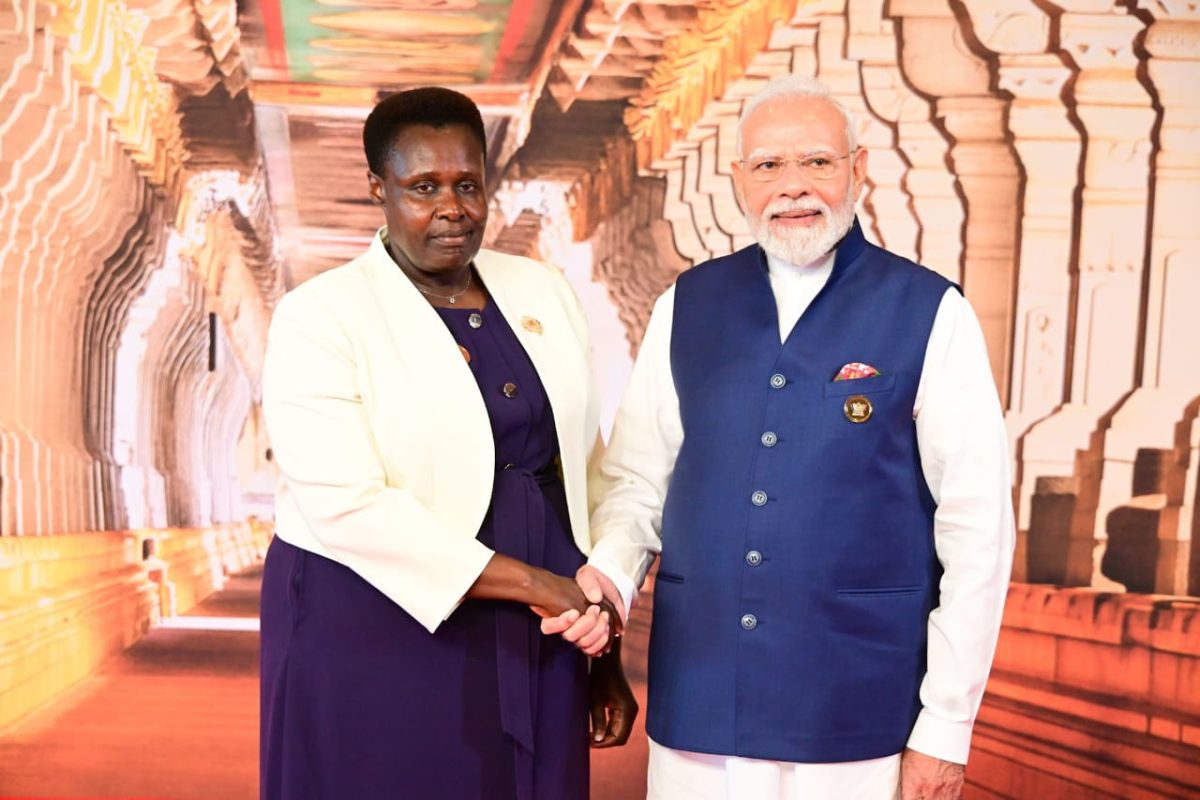
President Yoweri Kaguta Museveni has strongly defended BRICS as a legitimate response to what he described as renewed attempts by powerful countries to dominate the global order.
Museveni said BRICS should strengthen solidarity among emerging economies while promoting global prosperity, free trade and greater economic opportunities for developing countries.
In a speech delivered on his behalf by Vice President Jessica Alupo at the 18th BRICS Summit in New Delhi, India, Museveni said the grouping was necessary because countries that historically dominated the global economy had repeatedly used their power to disadvantage others.
“Therefore, BRICS is a correct response to the renewed efforts by the habitual mistake makers to dominate the World,” Museveni said.
He called for stronger cooperation among BRICS countries while urging engagement with Western powers based on equality and mutual benefit.
“It is, therefore, good to consolidate solidarity within the BRICS Countries, give help to one another and also work on principled reconciliation with the habitual mistake makers if they stop their chauvinism and parasitism,” he said.
Museveni’s address, titled “Long Live Global Affluence, Down With Chauvinism and Parasitism,” placed BRICS within the broader history of global economic inequality, colonialism and the struggle for control of international trade.
He traced the origins of modern global economic imbalances to the expansion of European powers following the Ottoman capture of Constantinople in 1453. Museveni said European efforts to find alternative routes to Asia eventually contributed to the expansion of European colonialism across Africa, Asia and other parts of the world.
He noted that by 1900, almost the entire African continent had been colonised, apart from Ethiopia, while India and other parts of Asia had also fallen under European colonial rule.
The President said African resistance eventually led to the liberation of the continent, pointing to the formation of the African National Congress in South Africa in 1912 and the achievement of majority rule in South Africa in 1994.
“A whole 5 centuries of our time wasted by chauvinists and parasites,” Museveni said.
BRICS and the spread of prosperity
Museveni argued that the rise of countries such as China, India and Vietnam demonstrates the potential of economic development outside the traditional centres of global wealth.
He contrasted the economic position of China and India in the 1960s with their current levels of development, arguing that increased prosperity in developing countries creates markets that also benefit advanced economies.
He cited Uganda’s potential economic transformation as an example. “When the GDP of Uganda per capita goes from the present USD 1,306 to USD 30,000, People in the USA will benefit,” he said.
Museveni said a wealthier Uganda would have greater capacity to purchase aircraft, machinery and other products from countries such as the United States.
“Therefore, the chauvinists and the parasites are enemies of everybody’s interests, including themselves,” he said. He also used Uganda’s iron and steel industry to illustrate how growing prosperity in developing countries can create demand for raw materials and manufactured products.
Museveni recalled that in 2003, a tonne of steel was selling for about USD 200 and Uganda struggled to attract investment into its high-grade iron ore because of what he described as a global glut of steel.
By 2023, he said, the price had risen to about USD 900 per tonne as demand increased with economic growth in China, India, Vietnam, Africa and other developing regions.
Uganda’s role in BRICS
Uganda became a BRICS partner country in January 2025, giving Kampala a platform to deepen economic and diplomatic engagement with some of the world’s major emerging economies.
The partnership is important for Uganda as it seeks greater access to trade, investment, technology, infrastructure financing and new markets across the Global South.
It also gives Uganda an opportunity to participate in discussions on global economic governance and advocate for a more equitable international trading and financial system.
The expanded BRICS grouping brings together major economies from Africa, Asia, the Middle East and Latin America, with Uganda among its partner countries.
Modi welcomes Alupo at BRICS Summit
Vice President Jessica Alupo represented Uganda at the New Delhi summit after being delegated by President Museveni.
Indian Prime Minister Narendra Modi welcomed Alupo and other participating leaders at Bharat Mandapam as the summit entered its second day.
Alupo was among leaders participating alongside prominent BRICS leaders, including Russian President Vladimir Putin, Chinese President Xi Jinping and South African President Cyril Ramaphosa.
Other leaders attending the summit included Egyptian President Abdel Fattah el-Sisi, Ethiopian Prime Minister Abiy Ahmed, Iranian President Masoud Pezeshkian and Indonesian President Prabowo Subianto.
India’s hosting of the 18th BRICS Summit has provided Uganda with an opportunity to strengthen its bilateral relationship with India while engaging other major economies across the Global South.
For Kampala, the summit comes as Uganda seeks to diversify its economic partnerships, attract investment, expand markets for Ugandan products and strengthen South-South cooperation.
Museveni used his address to says that BRICS should not simply be viewed as an alternative bloc, but as part of a broader effort to create a global economic system in which developing countries can pursue prosperity without domination.
“We must fight for global affluence and oppose chauvinism and parasitism. With global affluence, everybody will be a winner,” Museveni said.