

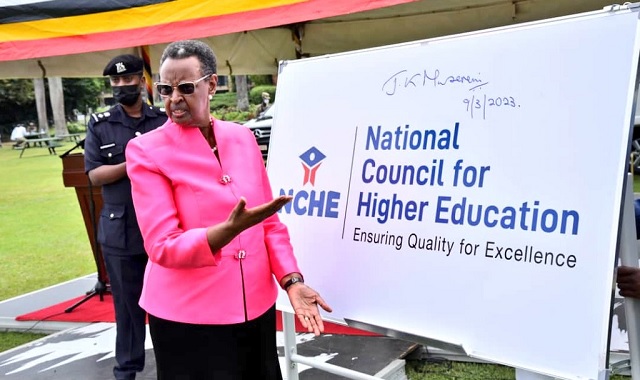
The National Council for Higher Education (NCHE) has launched career guidance and mentorship sessions for secondary school students in Gulu City, in order to ease their transition into higher learning institutions.
The sessions began on Friday morning at the Gulu University playground, where NCHE is hosting the 16th Annual Higher Education Exhibition, marking the first time the event is being held in Northern Uganda.
Hundreds of students from both public and private secondary schools across Gulu City attended the mentorship and counselling sessions, seeking guidance on academic programmes and potential career pathways.Speaking at the event, NCHE Executive Director, Prof. Mary Okwakol, underscored the critical role of mentorship in preparing students for higher education.
She noted that the sessions are designed to help learners make informed decisions when selecting universities and courses, emphasising the importance of enrolling in programmes accredited by NCHE to avoid pursuing unrecognised qualifications.
The Head of Standards, Recognition and Equating of Qualifications at NCHE, Dr David Musiimaami, said the sessions are focusing on key areas to safeguard students’ academic futures. He warned that students who enrol in unrecognised institutions risk wasting both time and financial resources, as such qualifications may not be accepted by the government or employers.
“We are informing students that after completing Senior Four and Senior Six, they must ensure they enrol in higher education institutions licensed by NCHE. We are also urging them to verify with NCHE whether a course or programme has been approved before enrolling,” Dr Musiimaami said.
Dr Musiimaami further emphasised the need to confirm the legitimacy of campuses and institutional branches, noting that some operate without proper authorisation. “Certificates, diplomas or degrees obtained from unlicensed campuses will not be recognised,” he cautioned.
The sessions also highlighted minimum entry requirements for certificate, diploma, and degree programmes, equipping students with knowledge of the academic performance required at both Senior Four and Senior Six levels. Gulu City Mayor Alfred Okwonga commended NCHE for the initiative, noting that access to career guidance remains limited in many schools, particularly in Northern Uganda.
He encouraged schools to take full advantage of the ongoing exhibition. He further called on NCHE to make such engagements more regular within the sub-region and urged the regulatory body to expand accreditation of science-based programmes to boost innovation.
Okwonga also advocated for stronger collaboration between secondary schools and higher learning institutions to ensure a smoother transition for learners.
More than 50 public and private universities and tertiary institutions, alongside policymakers, students, and industry players, are participating in the exhibition in Gulu City, showcasing innovations and exploring solutions to challenges facing the higher education sector.
Education officials at the exhibition also welcomed the gradual shift in Uganda’s curriculum from a theory-based model to a competence-based approach.
First rolled out in 2020 at the lower secondary level, the competency-based curriculum is now being extended to higher learning institutions.
The Ministry of Education has directed all institutions to begin aligning their programmes with the new model ahead of its full implementation in the 2027/2028 academic year. URN