



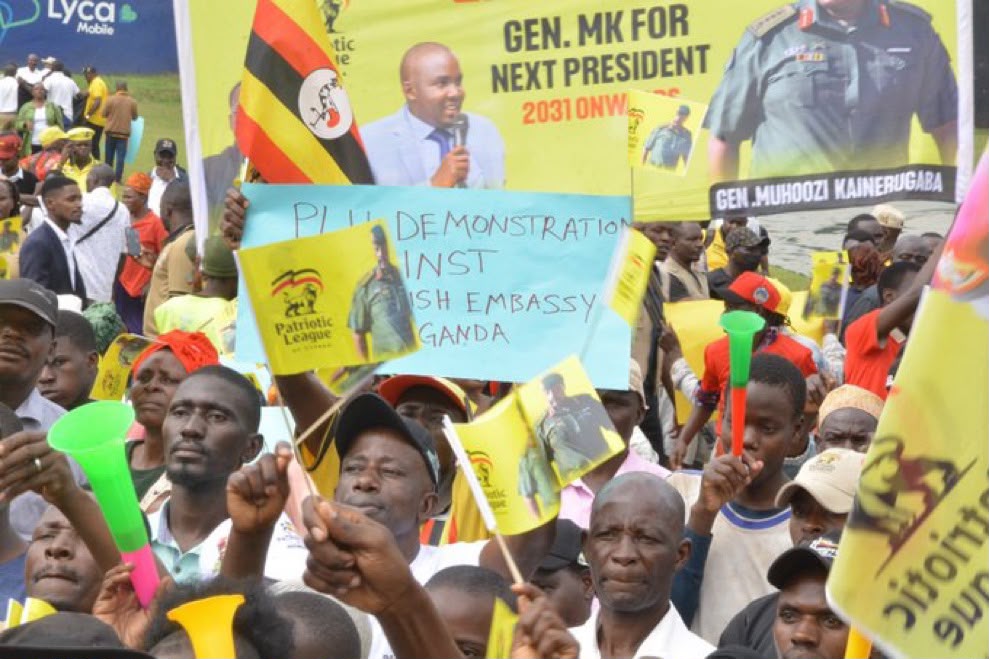
A directive from Uganda’s Chief of Defence Forces, Gen. Muhoozi Kainerugaba, has culminated in a Patriotic League of Uganda (PLU) demonstration at Türkiye’s Embassy in Kampala, intensifying scrutiny of demands for the extradition of government critic Fred Lumbuye.
What began as a complaint over a Ugandan national living in Türkiye has acquired wider diplomatic significance, raising questions about how the Ugandan state pursues demands involving its citizens abroad, how military leadership interacts with political mobilisation, and whether pressure directed at a foreign diplomatic mission can remain within the bounds of lawful protest and international diplomatic practice.
The demonstration, which began at Lugogo Cricket Oval and proceeded through Kololo streets to the Turkish diplomatic mission on Elgon Terrace Road, involved participants carrying placards and images of Kainerugaba, wearing T-shirts and using a mobile public-address system.
A scuffle between anti-riot police and PLU members ensued as demonstrators attempted to deliver a protest document to the closed embassy; by press time, it was unclear whether anyone was injured, arrested or charged from the confrontation.
//Cue In: “The problem is …
Cue out…Mama Janet Oyeeeee.”//
The mobilisation follows Gen. Kainerugaba’s September 9 announcement of a “full-force demonstration at the Turkish Embassy,” with PLU General Secretary Twalla Fadil assigned to coordinate the action. In response, the Turkish Embassy announced that it would close on September 18 because of the planned demonstration.
“We are demonstrating in full force at the Turkish Embassy on the 18th of September,” the General stated on Sept 9th. “Hon. Fadhil is in charge of this demonstration. PLU better do a good job. My order will not change this time. Instead we will arrest ANY Turkish agent who says anything different!”
At the centre of the dispute is one Fred Kajubi Lumbuye, a ferequent government critic based in Türkiye. Ugandan government supporters have demanded his extradition.
Kainerugaba, who is also the chairman of PLU, has publicly demanded that Türkiye return Lumbuye to Uganda. In September, he escalated his public position by announcing a demonstration and directing Turkish nationals to leave Uganda.
Extradition generally involves legal procedures governed by applicable domestic law, treaties or other arrangements between states. The requested state must consider the legal basis for surrender, the relevant offences, judicial requirements and any applicable human-rights protections.
URN could not independently verify the precise legal status of Lumbuye’s case, including whether a formal extradition request has been submitted, whether Turkish authorities have made a decision and whether any court proceedings are active.
Article 22 of the Vienna Convention on Diplomatic Relations requires the receiving state to protect the premises of a diplomatic mission against intrusion, damage and disturbance of the peace or impairment of its dignity. The convention also establishes the inviolability of diplomatic premises.
For Uganda, this means that the authorities have a responsibility to protect the Turkish Embassy while managing public demonstrations in accordance with domestic law. Public confrontations involving diplomatic missions can have consequences beyond the immediate protest.
They may affect the confidence of foreign missions, the perception of a country’s investment environment and the ability of diplomats to conduct routine engagements. Turkey and Uganda maintain formal diplomatic relations, with cooperation extending across trade and infrastructure. Such flashpoints risk chilling that engagement.
Ashiraf Kaddu, an activist in Kampala, criticised the use of military identity and state authority in support of a demand directed at Türkiye, arguing that “the UPDF should not be conflated with PLU.”
Equally, Martin Yiiga, argues that in Uganda expressing contrary views openly against the government of the day about poor governance and violation of fundamental human rights comes with risks to personal safety.
“For many leaving the country becomes the few way to speak freely and to raise awareness without facing such immediate risks to one’s life.”
Patrick Ssekabira, a concerned Ugandan in a separate reaction, apologised to the Turkish Embassy and its staff for the disruption reportedly caused by the demonstration.”Diplomatic duties should not be disrupted by political disputes,” he said, expressing support for justice, democracy and the rule of law.
Attempts to secure official statements from the UPDF, Uganda Police, the Foreign Affairs Ministry, and the Turkish Embassy failed, with contacted officials giving incoherent responses.